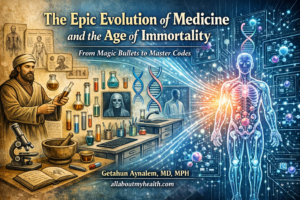
For most of human history, medicine was not a science—it was a philosophy of “balance.” From Ancient Greece through the mid‑19th century, physicians believed illness came from an imbalance of the four humors: blood, phlegm, yellow bile, and black bile. If you were sick, the cure was not to fight infection but to drain, purge, or rebalance your fluids. For nearly two thousand years, the most advanced medical tool was a blade used to remove “excess” life from the body.
But every few centuries, the world tilts. Today, we are living through one of the most profound shifts in medical history: the transition from reactive medicine (fixing the body after it breaks) to proactive biological design (programming the body to stay young, healthy, and resilient).
- The Foundations (Pat Turning Points): Mapping the Human Machine
The journey toward modern medicine began when we stopped viewing the body as a mystical vessel and started treating it as a complex, understandable machine.
1543 — The Anatomical Revolution
Before Andreas Vesalius, medical knowledge relied on ancient Roman texts based largely on animal dissections. Vesalius’s landmark 1543 work, De humani corporis fabrica, insisted that physicians must study the human body directly. His anatomical maps transformed the “soul’s vessel” into a biological machine that could be observed, measured, and repaired.
The 19th Century — The Discovery of the Invisible Enemy
Before Germ Theory, surgeons moved between autopsies and childbirth without washing their hands. Louis Pasteur and Robert Koch revealed that microscopic pathogens—not bad air or humoral imbalance—caused disease. This breakthrough gave rise to sanitation, antiseptics, and vaccines, dramatically reducing mortality.
1928 — The Antibiotic Age
Alexander Fleming’s discovery of penicillin introduced the first true “magic bullet”—a drug that could kill bacteria without harming the host. Diseases like pneumonia and sepsis, once near-certain killers, became treatable. Chemistry became a weapon against infection.
The 20th Century — The Technological Triple Threat
By the mid‑1900s, three revolutions converged to redefine medicine:
- Imaging: X‑rays, CT scans, and MRIs allowed doctors to see inside the body without a single incision.
- Anesthesia: Surgery became a controlled, humane, and precise discipline.
- Genetics: The discovery of DNA’s double helix revealed the software code of life itself.
These breakthroughs laid the foundation for the digital and biological revolutions now underway.
- The Digital Shift (Current Turning Points): Programming the Body
Medicine is rapidly evolving from standardized treatments to personalized, data‑driven, genetically informed care. We are entering an era where biology behaves like software.
mRNA Technology — Software for the Immune System
The rapid development of mRNA vaccines demonstrated that we can “program” immune cells with digital instructions. This same platform is now being used to train the body to recognize and destroy cancer cells, turning the immune system into a customizable defense system. The COVID-19 response proved we can “program” our immune systems.
AI — The Diagnostic Super‑Brain
Artificial intelligence is already outperforming human specialists in detecting early‑stage cancers, heart disease, and retinal changes that predict future illness. AI can spot patterns invisible to the human eye, enabling earlier intervention and dramatically improved outcomes.
AI tools like retinal age tests can even spot warning signs of heart or brain problems before symptoms appear.
Personalized Genomics — Medicine Tailored to Your DNA
We are moving away from one‑size‑fits‑all medicine. Genetic sequencing now guides drug selection, dosage, and risk prediction. Your genome—not population averages—will increasingly determine your treatment plan.
III. The Longevity Revolution (The Future): The Science of 150
The most radical shift in modern medicine is the move from treating diseases to treating aging itself. Researchers are no longer viewing 80 as an inevitable expiration date. Researchers now view aging not as an inevitable decline but as a software error—a loss of biological information that can be repaired.
Cellular Reprogramming — The Biological Reset Button
The Sinclair Lab at Harvard is pioneering “Information Theory of Aging,” which suggests aging is a loss of epigenetic information—like scratches on a CD. Using modified “Yamanaka factors,” scientists have successfully reversed aging in animal tissues by up to 75% within weeks. Human trials for epigenetic reprogramming are expected to begin in early 2026, initially targeting vision loss from glaucoma.
Senolytics — Eliminating Zombie Cells
As we age, some cells stop dividing but refuse to die. These “zombie” or senescent cells accumulate and release toxic inflammatory signals that accelerate aging. New drugs called senolytics (like Dasatinib and Quercetin) target and selectively eliminate these zombie cells, showing promise in reversing osteoarthritis, improving cardiovascular health, and extending healthy lifespan.
The Blueprint of the Blue Zones
While high-tech interventions arrive, researchers continue to study Blue Zones—regions like Sardinia and Okinawa where people regularly live to 100. Their longevity secrets include plant-based diets, daily movement, strong social ties, and low chronic stress. The data suggests that even without labs, plant-based diets and social connectivity can add nearly a decade of healthy life.
- The Science‑Fiction Reality (Future Turning Points): The Age of Biological Design
The next frontier of medicine is not treatment, it is design (direct biological intervention). We are beginning to engineer biology with precision.
- CRISPR Gene Editing: The transition from treating symptoms to permanently deleting genetic diseases from the human lineage. Using genetic scissors to delete hereditary diseases from a family’s bloodline forever.
- 3D Bioprinting & Regrowth: Using 3D printers to “grow” and print replacement organs—hearts, kidneys, livers—from a patient’s own cells, ending the organ donor shortage.
- Nanomedicine: Deploying molecular-scale robots to perform surgery or deliver drugs at the cellular level. Microscopic robots capable of delivering drugs, repairing tissues, or performing cellular‑level surgery without a single incision.
These technologies move medicine from healing to creation.
- Conclusion: The Responsibility of the Gods
From leeches to nanobots, from humors to genetic code, the arc of medicine bends toward mastery over biology. For the first time in history, we are gaining the ability to rewrite our biological destiny—to slow aging, prevent disease, and potentially extend human life far beyond today’s limits.
But with this power comes a profound question: If we can print organs, edit genes, and halt aging, what does it mean to be human?
The history of medicine has been a long war against death. We are finally winning. Now we must decide what to do with the victory.
To explore more essential health insights, visit – https://allaboutmyhealth.com/