The World Has Changed—Should the WHO Definition of Health Change Too? A Proposal to Modernize the WHO Definition of Health for the 21st Century
Introduction: Why the WHO Definition of Health Needs an Update
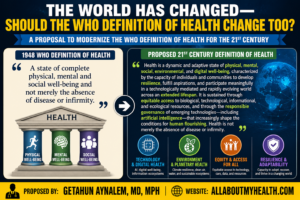
Since 1948, the World Health Organization (WHO) has defined health as:
“A state of complete physical, mental and social well-being and not merely the absence of disease or infirmity.”
At the time, this definition was groundbreaking. It challenged the narrow biomedical view of health and recognized that well-being extends beyond the treatment of disease. However, over the decades, scholars, policymakers, and public health experts have increasingly criticized the definition for being overly idealistic, difficult to measure, and disconnected from the realities of modern life.
Today, humanity faces challenges and opportunities unimaginable in either 1948 or 1984. Artificial intelligence, digital ecosystems, climate change, biotechnology, and increasing life expectancy are transforming the conditions that shape human well-being. As discussed in our article on Artificial Intelligence in Healthcare, emerging technologies are already reshaping diagnosis, treatment planning, and healthcare delivery on a global scale.
As a result, a modernized definition of health is needed—one that reflects the realities of the 21st century while preserving WHO’s commitment to equity, dignity, and human flourishing.
The Evolution of Health: From Disease Prevention to Human Flourishing
Health has traditionally been viewed through three major lenses:
The Biomedical Model
This model defines health primarily as the absence of disease or physical dysfunction. While effective for diagnosing and treating illness, it overlooks psychological, social, and environmental influences on well-being.
The Holistic Health Model
The 1948 WHO definition expanded health to include physical, mental, and social dimensions, laying the foundation for modern public health and preventive medicine.
The Adaptive and Resilience-Based Model
The 1984 WHO framework shifted the focus toward adaptability, resilience, and the ability to cope with life’s challenges—a concept increasingly supported by contemporary health science.
Today, public health experts recognize that chronic illnesses, environmental conditions, and social determinants interact in complex ways. This reality is evident in the growing burden described in The Global Rise of Non-Communicable Diseases, where lifestyle, environmental, and socioeconomic factors increasingly shape health outcomes worldwide.
Why a New Definition of Health Is Needed
Digital and Algorithmic Determinants of Health
Digital technologies have become powerful drivers of health outcomes.
Social media platforms influence mental health, identity formation, and social relationships. Search engines and online communities shape access to health information, while misinformation can directly affect public health behaviors. Meanwhile, artificial intelligence increasingly guides medical diagnosis, clinical decision-making, patient triage, and healthcare delivery.
According to research from the Organisation for Economic Co-operation and Development, digital health technologies are becoming central to healthcare transformation worldwide.
Digital well-being has therefore become an essential component of overall health.
Climate Change and Environmental Health
Environmental conditions have emerged as some of the most significant determinants of health worldwide.
Rising temperatures, extreme weather events, air pollution, biodiversity loss, and water insecurity contribute to increased rates of respiratory disease, cardiovascular illness, infectious disease spread, food insecurity, and mental health challenges.
Organizations such as the World Health Organization and the United Nations Development Programme increasingly recognize climate change as one of the greatest threats to global health.
Health can no longer be separated from ecological sustainability.
The Longevity Revolution
Advances in biotechnology, regenerative medicine, genomics, and geroscience are extending human lifespan and reshaping our understanding of aging.
The focus is increasingly shifting from longevity alone to healthspan—the number of years individuals live in good health and functional independence. Readers interested in this topic may also explore The Science of Aging: How to Prevent and Manage Age-Related Conditions, which examines emerging approaches to healthy aging and disease prevention.
A contemporary definition of health must recognize the importance of thriving across longer lives.
Information Health and Cognitive Well-Being
A growing body of research suggests that information environments influence health outcomes much like physical environments.
Exposure to misinformation, disinformation, digital manipulation, and information overload can affect mental health, public trust, healthcare decisions, and societal resilience.
The COVID-19 pandemic and the rise of persistent conditions discussed in Understanding Long COVID: Symptoms, Recovery, and Research demonstrated how information quality can significantly affect public health responses and outcomes.
Healthy information ecosystems are becoming a public health necessity.
Equity in a Technology-Driven World
Health disparities are no longer driven solely by income, geography, or healthcare access.
The digital divide, unequal access to data, AI-powered healthcare tools, internet connectivity, and advanced medical technologies increasingly determine who benefits from modern health innovations.
Research from the World Bank highlights how access to digital infrastructure is becoming a key determinant of economic and health equity worldwide.
A modern health definition must recognize technological equity as a fundamental health issue.
Emerging Biological and Environmental Challenges
The twenty-first century is also witnessing rising rates of chronic inflammatory conditions, allergies, autoimmune diseases, and environmentally influenced illnesses.
As explored in The Rise of Allergies: What’s Changing and Why?, changing lifestyles, environmental exposures, and biodiversity loss may be contributing to the increasing prevalence of allergic diseases globally.
These trends further illustrate why health must be viewed through a broader and more integrated lens.
A Proposed Modern Definition of Health
Integrated Contemporary Definition of Health
“Health is a dynamic and adaptive state of physical, mental, social, environmental, and digital well-being, characterized by the capacity of individuals and communities to develop resilience, fulfill aspirations, and participate meaningfully in a technologically mediated and rapidly evolving world across an extended lifespan. It is sustained through equitable access to biological, technological, informational, and ecological resources, and through the responsible governance of emerging technologies—including artificial intelligence—that increasingly shape the conditions for human flourishing. Health is not merely the absence of disease or infirmity.”
How This Definition Improves Upon Previous WHO Definitions
Preserves the Holistic Vision of 1948
Physical, mental, and social well-being remain foundational pillars of health.
Builds on the Resilience Framework of 1984
Health is viewed as a dynamic capacity for adaptation rather than a static condition.
Incorporates Modern Determinants of Health
The proposed definition recognizes critical influences on well-being, including:
- Digital health and digital well-being
- Artificial intelligence in healthcare
- Information ecosystems
- Environmental sustainability
- Climate resilience
- Healthy aging and longevity
- Community resilience
Strengthens Health Equity
The proposal acknowledges that access to technology, information, healthcare innovation, and environmental resources has become central to global health justice.
Supports Measurement and Policy Development
Unlike the idealized concept of “complete well-being,” the proposed framework focuses on measurable capacities, resilience indicators, and social determinants that can guide research, healthcare planning, and policy implementation.
Implications for Global Health Policy
Advancing Digital Health Governance
Governments would be encouraged to address digital health literacy, AI oversight, cybersecurity, and online health misinformation as public health priorities.
The work of the Organisation for Economic Co-operation and Development and the World Health Organization provides important frameworks for responsible digital health governance.
Integrating Climate and Environmental Health
National health strategies would increasingly align with environmental sustainability and climate resilience initiatives.
Supporting Healthy Aging
Healthcare systems would prioritize extending healthspan, preventing chronic disease, and promoting lifelong functional well-being. This approach aligns closely with emerging research in aging science and with innovations discussed in Advancements in Cancer Treatment: What’s on the Horizon?, where precision medicine and personalized therapies are extending both survival and quality of life.
Strengthening Technological Equity
Investment in digital infrastructure, telehealth access, and equitable deployment of emerging technologies would become essential public health objectives.
Promoting Community and Societal Resilience
Health systems would focus not only on treating illness but also on building social cohesion, preparedness, adaptability, and resilience.
The Future of Health in the 21st Century
The factors shaping health today extend far beyond biology. Data, algorithms, climate systems, information networks, and emerging technologies increasingly influence how people live, age, access care, and participate in society.
Leading researchers associated with the Lancet Commission on Future Health have emphasized that future health frameworks must integrate planetary health, digital transformation, and social equity into a unified model of human well-being.
As healthcare enters an era defined by artificial intelligence, precision medicine, digital connectivity, and environmental uncertainty, our understanding of health must evolve accordingly.
Conclusion
The world has entered a new era in which health is shaped as much by technology, information, and ecosystems as by traditional biological factors. The WHO’s original definition transformed global thinking about health in the twentieth century. A new definition can do the same for the twenty-first.
By integrating resilience, digital well-being, environmental sustainability, healthy longevity, technological equity, and responsible AI governance, this proposed framework offers a more comprehensive and actionable vision of health—one capable of guiding public health policy, healthcare innovation, and human flourishing for generations to come.
For healthcare leaders, policymakers, researchers, and citizens alike, the question is no longer whether health is changing—it is whether our definition of health is evolving quickly enough to keep pace with the world it seeks to describe.
To explore more essential health insights, visit – https://allaboutmyhealth.com/